If you’re writing memoir…free course

I’m currently taking the non-fiction course offered by scribewriting.com. With a number of resources and ample instructor expertise, the logical and methodical approach been very helpful in addressing audience and outlining the larger project. [Tomorrow, we will cover more of the actual writing of the book and on Friday, they are offering a Q. and A. session that will last at least an hour.]

These same folks will be teaching a free course on memoir next week.

Follow this link to sign up: https://scribewriting.com/bookschool/

Just thought I would pass along the info for those considering a new non-fiction project.

Curation Corner: Writerly Wisdom


Henry Miller’s 11 Commandments of Writing
Thanks to Maria Popova’s Brain Pickings for this excellent page that includes Miller’s ‘daily program’.

My favorites: 

  1. Work on one thing at a time until finished.
  2. Don’t be nervous. Work calmly, joyously, recklessly on whatever is in hand.
  3. Forget the books you want to write. Think only of the book you are writing.

This 21 Authors Share One Piece of Advice for Writers post by Robert Lee Brewer from Writer’s Digest could easily be a springboard for 21 separate posts. The word cloud above offers a few items from the article. Take a look.

Curation Corner: Henry Miller’s 11 Commandments of Writing

HENRY MILLER Word CloudHenry Miller’s 11 Commandments of Writing

Thanks to Maria Popova’s Brain Pickings for this excellent page that includes Miller’s ‘daily program’.

My favorites: 

  1. Work on one thing at a time until finished.
  2. Don’t be nervous. Work calmly, joyously, recklessly on whatever is in hand.
  3. Forget the books you want to write. Think only of the book you are writing.


Curation Corner: On sticking to your story, a daily 15 minutes, and chipping away

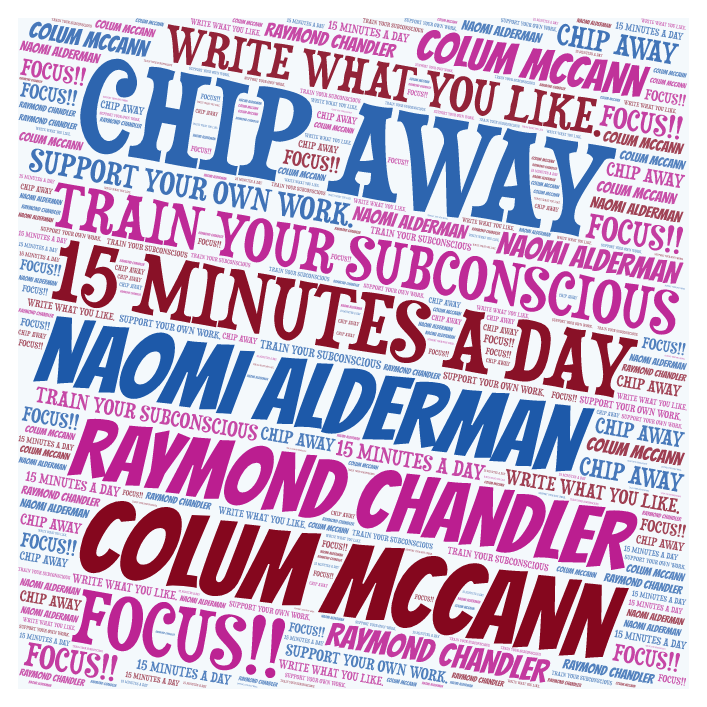
ALDERMAN McCANN CHANDLER WRITERS WORD CLOUD
Don’t ever write anything you don’t like yourself and if you do like it, don’t take anyone else’s advice about changing it. They just don’t know.

RAYMOND CHANDLER

***

Write for fifteen minutes every day. Set a time in advance, set a timer. Try to write at the same time every day. Your subconscious will get used to the idea and will start to work like a reliable water spout.

NAOMI ALDERMAN

***

The terror of the white page never goes away, no matter how much you publish. Do you know how terrified I was this morning, as I woke up and walked into my latest novel? And it doesn’t get any better. Every time I finish a piece of work, I am completely terrified that I’m going to be found out, that I’m a charlatan, that I have nothing left anymore. That I can’t do it anymore. It’s no good; I’ve lost touch. Through all of that, you find another block of stone. You just continue to carve and chip away.

COLUM McCANN

***

Thanks to Jon Winokur–via his Twitter feed– and his Advice to Writers for these first three quotes.

Curation Corner: Bradbury, Goldberg, and Faulkner quotes

From the ‘Do as I share, not as I do’ department:

writers quotes wisdom Bradbury 2

When you write – explode – fly apart – disintegrate! Then give time enough to think, cut, rework, and rewrite.

RAY BRADBURY

From the ‘Cripes, I hate it when people make me feel responsible for my own life’ department…
Sometimes people say to me, “I want to write, but I have five kids, a full-time job, a wife who beats me, a tremendous debt to my parents,” and so on.

I say to them, “There is no excuse. If you want to write, write. This is your life. You are responsible for it. You will not live forever. Don’t wait. Make the time now, even if it is ten minutes once a week.’

NATALIE GOLDBERG

From the ‘Benefits of setting the bar low’ department: 

Always dream and shoot higher than you know you can do. Don’t bother just to be better than your contemporaries or predecessors. Try to be better than yourself.

WILLIAM FAULKNER


Curation Corner: Showing up…

messy desk jesus-hilario-h-5v69Vl62NCM-unsplash

A recent item from Jon Winokur’s Advice to Writers…

You Have to Show Up Every Day

Sometimes you really have to shove and grunt and sweat. Some days you go to your office and you’re the only one who shows up, none of the characters show up, and you sit there by yourself, feeling like an idiot. And some days everybody shows up ready to work. You have to show up at your office every day. If an idea comes by, you want to be there to get it in.
THOMAS HARRIS

***

My take: For me, there is something magical about getting in that first 100 words. They don’t have to be quality words, of course, but just getting me to notice that I ‘showed up’ is a forward step.

I start the day in my notebook quite simply: “Showing up–the date–First 100 words” and I take it from there. The total often stretches to 150+ words. Interesting, though: There are times when I enter the list-making ‘zone’, so even if I don’t reach the century mark, I know those are quality words that are giving my work some added focus.

**Photo by Jesus Hilario H. on Unsplash

Curation Corner: In times of uncertainty…

how creativity can help.

Four key points from Diana’s citiesatdawn.com post.

  • Creativity is a way to work things out.
  • Creativity allows us a chance to see other possibilities.
  • Creativity brings calm to our minds and bodies.
  • Creativity opens the door to engaging our imaginations and going beyond ourselves.

get the creativity flowing--tim-mossholder-SZgVZPbQ7RE-unsplash
Photo by Tim Mossholder on Unsplash