
Curation Corner: One writer’s mindshift
Branching out with my writing
 This quote from William Zinsser [On Writing Well is his best-known work.] takes an opposite tack to yesterday’s Writing With No Direction post.
Writing is linear and sequential; Sentence B must follow Sentence A, and Sentence C must follow Sentence B, and eventually you get to Sentence Z. The hard part of writing isn’t the writing; it’s the thinking. You can solve most of your writing problems if you stop after every sentence and ask: What does the reader need to know next?
WILLIAM ZINSSER
Curated from my daily email from Jon Winokur’s https://advicetowriters.com/

This snappy piece by David Ben-Ami really speaks to the value of Julia Cameron’s ‘morning pages’. (Dropping two names in one sentence. Have I no shame?)

The ordinary writer is bound to be assailed by insecurities as he writes. Is the sentence he has just created a sensible one? Is it expressed as well as it might be? Would it sound better if it were written differently? The ordinary writer is therefore always revising, always chopping and changing, always trying on different ways of expressing himself, and, for all I know, never being entirely satisfied.
–ISAAC ASIMOV
Visitors: Share other writing website suggestions.
↓↓↓↓↓↓↓↓↓↓↓↓↓↓↓↓↓↓↓↓↓
 It’s easy to urge each other to crank out ideas and imagery.
There you go! You can now send your work on to the Pulitzer Prize committee.
Suggestion: Schedule a 15-minute visit to Copyblogger.You’re sure to leave with useful, shareable content.
Visitors: Share other writing website suggestions.
↓↓↓↓↓↓↓↓↓↓↓↓↓↓↓↓↓↓↓↓↓

I recently signed up for daily delivery of Jon Winokur’s Advice to Writers, so I’m essentially curating his own curation. Today’s advice comes from Australian writer [and then some] Clive James.
“The only thing I’ve got better at as the years have gone by is I’ve grown more resigned to the fact that it comes hard. You realize that hesitation and frustration and waiting are part of the process, and you don’t panic. I get a lot better at not panicking. I get up every morning early if it’s a writing day and I will do nothing else but write that day. But the secret is not to panic if it doesn’t come.”
And whoa, what a wealth of resources you will find at advicetowriters.com.
and much more under the ‘Resources’ tab.
Enjoy.
Chime in below with your own favorite writing website.
I appreciated Mary Gaitskill’s wisdom in this item I gleaned from advicetowriters.com
Here’s an excerpt from the excerpt:
“When you’re writing on the computer, you don’t cross it out, you just delete it. But now, if I’m not sure, I don’t delete it. Instead of making the revision, I just put it in a bracket and write my second idea, and I can look back and see which I think was better, because sometimes the first thing is actually better.“


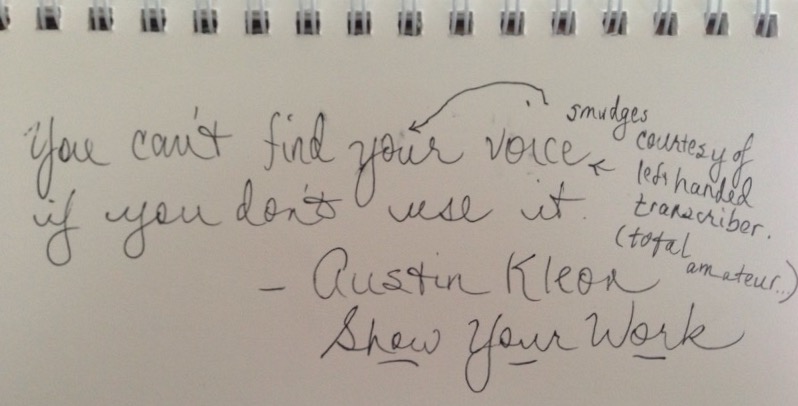
A few valuable posts on author’s voice…
Reclaiming My Writer’s Voice
by Kay Bolden
My favorite lines from the post:
The keyboard and the screen made it far too easy to distance myself from my words. To sink into sales mode or trope mode or campaign mode. When I write by hand, I lead with my body, not my brain.
How I Found My Writing Voice and How You Can Find Yours:
A Metaphor Involving Sandwiches
by Carly Mae
Some favorite lines from this post:
Our writing is not genuine, we don’t feel like ourselves, or it’s stilted and mechanical — feeling more like a “I have to write” versus “I want to write.”
If you feel that way, you might be lacking your voice.
***
The biggest reason your writing feels mechanical and stilted is because it is. It’s not you. So when you read it, it probably sounds fake.
Your audience reads it that way it too.

 Word Inventions