This quote from William Zinsser [On Writing Well is his best-known work.] takes an opposite tack to yesterday’s Writing With No Direction post.
Writing is linear and sequential; Sentence B must follow Sentence A, and Sentence C must follow Sentence B, and eventually you get to Sentence Z. The hard part of writing isn’t the writing; it’s the thinking. You can solve most of your writing problems if you stop after every sentence and ask: What does the reader need to know next?
This snappy piece by David Ben-Ami really speaks to the value of Julia Cameron’s ‘morning pages’. (Dropping two names in one sentence. Have I no shame?)
The ordinary writer is bound to be assailed by insecurities as he writes. Is the sentence he has just created a sensible one? Is it expressed as well as it might be? Would it sound better if it were written differently? The ordinary writer is therefore always revising, always chopping and changing, always trying on different ways of expressing himself, and, for all I know, never being entirely satisfied.
–ISAAC ASIMOV
It’s easy to urge each other to crank out ideas and imagery.Countless articles and posts urge us to dive in and heat up that pen or keyboard.But what about those next steps, where the real work kicks in?Copyblogger editor-in-chief Stefanie Flaxman’s Traffic Light Revision Technique weaves much-needed, but often elusive, objectivity into her approach to revision/editing.
Let’s boil it down:
Read over your material in a word processing document. [‘Document 1’] Color-code your sentences–green for ‘okay with me’, yellow for ‘needs some work’, red for ‘needs complete overhaul’. [Note: Use your own file-naming strategies.]
Save ‘Document 1’, without any further tinkering.
Create a copy of ‘Document 1’ [‘File’, ‘Save as…’], complete with the colored highlights. Name it ‘Document 2’.
Edit Document 2, recoloring your sentences green when satisfied with the work they’re doing.
Proofread your work [aloud is always a good idea] with the following question as your beacon:
Better yet, just pour yourself some coffee/tea, snag a treat, and follow the links below…
I have watched these shows multiple times and inevitably dream of a pastry/bread-driven road trip. Note: The people are just as appealing as the treats.
“The only thing I’ve got better at as the years have gone by is I’ve grown more resigned to the fact that it comes hard. You realize that hesitation and frustration and waiting are part of the process, and you don’t panic. I get a lot better at not panicking. I get up every morning early if it’s a writing day and I will do nothing else but write that day. But the secret is not to panic if it doesn’t come.”
Such as, from the nation of Georgia, shemomedjamo–the inability to stop eating a food item or meal. Usage: He reached for the unopened bag of kettle corn, knowing full well that shemomedjamo was inevitable.
Or, from Ghana, pelinti–to move hot food around in your mouth. Usage: Viewers were subjected to a full minute of pelinti when Guy Fieri chose to dive right into the queso that came straight from the oven.
I dare you…weave a few of these gems into a conversation this week.
Reminder: Simply restricting one or more of the five senses will heighten the others. [Try closing your eyes while eating. You will most likely hear your chewing more distinctly and I’ve found more flavors are pronounced. But hey, maybe that’s just me. But really, try it.]
Anxiety lurks around every corner.
War ain’t great.
Ditto nuclear devastation.
**And painful alliteration? The worst.
But that all pales compared to…
cinnamon rolls without the ooze.
And there it sat, taunting me…Do I have enough cinnamon/sugar/butter goo coursing through my folds and crevices? Or am I just a lifeless, arid mass of flour and yeast?
Taunt away, dough boy! I’m ready for you!
Thank you, Ree Drummond. [And thank you foodie friend, L.O., for the recommendation.]
To quote the Food Network star: “It really should be called ‘Brown Sugar Sauce’.”
Not one to quibble over semantics, I share with you, The Pioneer Woman’s Easy Caramel Sauce.
• 1 cup Brown Sugar
• 1/2 stick Butter (4 Tablespoons)
• 1/2 cup Half-and-half Or cream (Cream will make it thicker.)
• 1 Tablespoon Vanilla
• Pinch Of Salt
— Mix everything in over medium heat. Whisk gently for about six minutes.
— Stop when you’ve reached a desired thickness.
— Serve warm or cold.
Added musings:
I’ll be mixing in cinnamon to a portion of the remaining sauce before reheating.
I may well add a little maple syrup to another portion.
Well, gee, how about some pre-reduced brandy or amaretto to another portion?
Conclusion: Whether it’s straight or doctored caramel, dry, disappointing cinnamon rolls are now a thing of the past.
Two other relevant photos:
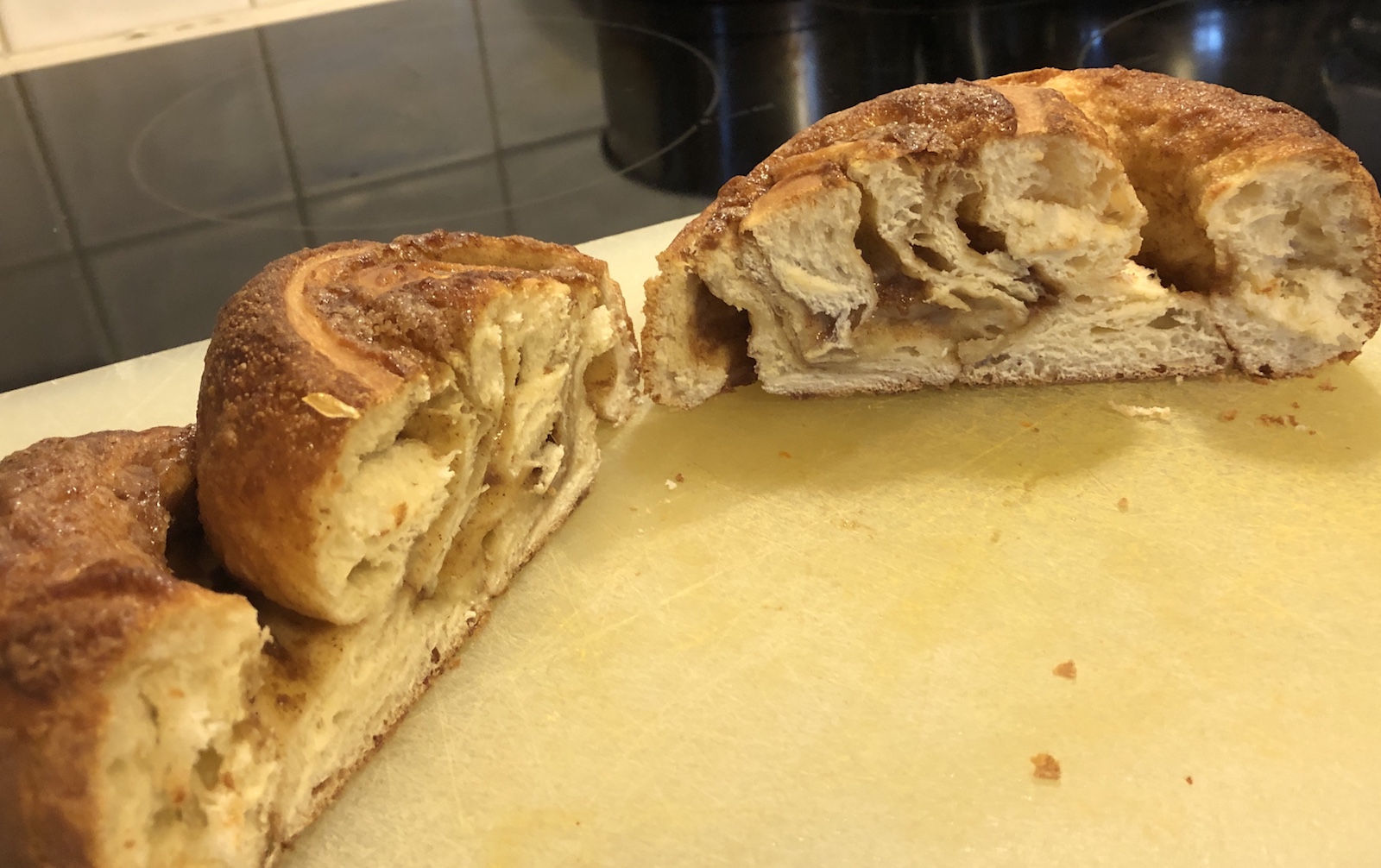
Question 1: Did this roll’s interior call for the sauce? I say, yes. I give it a C-. Where’s the cinnamon?My first attempt a month ago had a richer, darker tone, but a certain someone ran out of brown sugar.
Lest you think I’m leaving without another little morsel on writing…
 This quote from William Zinsser [On Writing Well is his best-known work.] takes an opposite tack to yesterday’s Writing With No Direction post.






 Word Inventions