More takeaways from Austin Kleon’s Show Your Work

Opening comment: I hope readers gain even half the value as I do from writing this down freehand and rehashing/posting it.

But feel free to throw money, coffee, good pastries, or an ‘I adopted a shelter pet!’ certificate my way. [I’m a pretty simple guy, really.]

So, more takeaways from one of my daily go-to books for changing/reinforcing my thinking:  Austin Kleon’s Show Your Work:  **

Become a Documentarian of What You Do.  

“Whether you share it or not, documenting and recording
your process as you go alonreading-at-desk-1200g has its own rewards. You’ll start to see the work you’re doing more clearly and feel like you’re making progress.” [It’s what I’m trying to do at jrmays.com.]


Be an Amateur  

“Because they have little to lose, amateurs are willing to try anything and share the results. They take chances, experiment, and follow their whims.” [I have a poster on my wall: If not now, when?  Works for me.]

“The world is changing at such a rapid rate, it’s turning us all into amateurs. Even for professionals, the best way to flourish is to retain an amateur’s spirit and embrace uncertainty and the unknown.”

Read Obituaries.

“Reading about people who are dead now and did things with their lives makes me want to get up and do something decent with mine.” [In his case, be a good dad and husband, create, curate, and share art and experience.]

He continues, “Take inspiration from the people who muddled through life before you–they all started out as amateurs, and they got where they were going by making do with what they were given and having the guts to put themselves out there. Follow their example.”

** Not aiming for anything –no commission, no pats on the back, no genuflections–other than to share good work by others.

Adding to my distractedness…two signups


but these are worth the risk…

Writing a Genre Series: The Perils and the Pitfalls! Heard about this through reedsylive .

Teachable Summit  [Lots of expertise and food for thought here. The challenge is to rein yourself in and not try to cover and do everything that interests you. Then again, look who’s talking…


Teacher eCards available…

With the arrival of Teacher Appreciation Week, I thought I’d offer a set of nine ecards to send to/share with friends and colleagues. [I’ve added a slide with three suggestions for how you can use them ‘out of the box’.] Sample below.

brunhildes-castle-no more home visits

Home visits–not always a good idea.

***

Yes! Send me the free ecards!

Go back

Your message has been sent

Warning
Warning

Warning.


Quieting the Lizard Brain [Seth Godin]

I would say that I need this reminder at least once a week. All 18 minutes are worthwhile. If you’re in a hurry, you can skip to minute 11.

Says Steven Pressfield about resistance: RESISTANCE IS MOST POWERFUL AT THE FINISH LINE. (page 18 in his The War of Art)

If You’re Trying to Teach Kids How to Write: What I’ve gleaned…

If You’re Trying to Teach Kids How to Write, You’ve Gotta Have This Book is one of the books I’ve been revisiting.

I probably never turned to page 20 when I used it for teaching, but the author insisted that we readers [i.e. teachers] take an inventory of ourselves as writers.

Fair enough…

Here were the questions she posed:

1. Do you like writing?

I absolutely do like writing, but I’m probably in a large club of writers who prefer the thrill of first-draftish writing–getting the ideas on paper. I also prefer pen-and-notebook to composing on a screen.

2. Do you think writing is hard, or easy, or both?

Writing is most certainly both. As I stated above, I do like first drafts, but it seems when it’s revision time, the hateful editor creeps in with not just nasty comments about word choice, etc. but more than a few intimations that my whole project–no matter how miniscule–is of questionable value. That’s when writing is hard. It’s also annoyingly difficult when a version from two weeks ago sounds better than what is currently on the screen.

3. How do you feel about yourself as a writer?

I don’t work hard enough. I don’t read enough. I don’t work past first draft level enough. Enough [catching the theme here?] said.

4. Have you grown as a writer in the past five years? How?

In some ways, I have grown as a writer. For one, posting this Q. and A. is a sign of growth. Working from resources like Jeff Goins’ You Are a Writer, Austin Kleon’s Show Your Work, and Mark Levy’s Accidental Genius shows I’m taking this all more seriously.

5. Can you identify your strengths and weaknesses as a writer?

Along with the shortcomings mentioned in answer #3, I get bogged down with muddy middles and I let resistance waylay me far too often. [Sorry, S Pressfield! I’ll keep working on that.]

Strengths–I think I’ve come up with interesting premises for stories. And I’ve been told my dialogue isn’t bad.


Using an image and video for my post today…

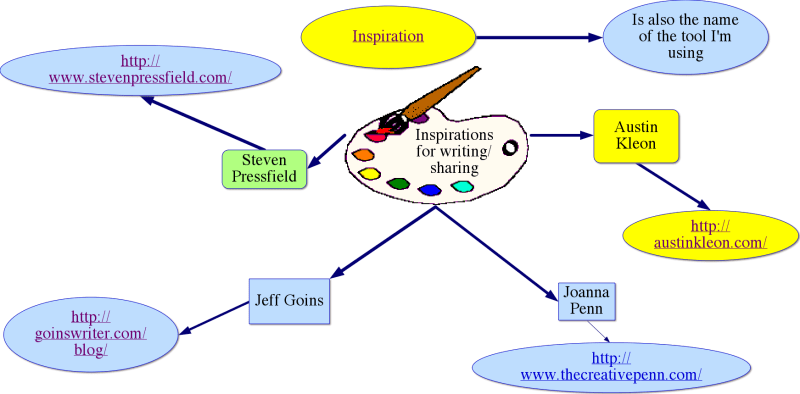
Thought I would try some different post formats. I used the mindmapping software Inspiration today. Below is an image file of what I wanted to communicate to you.

Below the image is a video demonstrating a few of Inspiration‘s features. [Reminder: I’m not trying to sell anything–just sharing what I like to experiment with.]


inspirations-for-writing-2


The video is seven minutes long, so feel free to fast-forward at your convenience! Will work on my paring-down skills, I promise.