Curation Corner: The Traffic Light Revision Technique

It’s easy to urge each other to crank out ideas and imagery.
Countless articles and posts urge us to dive in and heat up that pen or keyboard.
But what about those next steps, where the real work kicks in?
Copyblogger editor-in-chief Stefanie Flaxman’s Traffic Light Revision Technique weaves much-needed, but often elusive, objectivity into her approach to revision/editing.

Let’s boil it down:

  1. Read over your material in a word processing document. [‘Document 1’] Color-code your sentences–green for ‘okay with me’, yellow for ‘needs some work’, red for ‘needs complete overhaul’. [Note: Use your own file-naming strategies.]
  2. Save ‘Document 1’, without any further tinkering.
  3. Create a copy of ‘Document 1’ [‘File’, ‘Save as…’], complete with the colored highlights. Name it ‘Document 2’.
  4. Edit Document 2, recoloring your sentences green when satisfied with the work they’re doing.
  5. Proofread your work [aloud is always a good idea] with the following question as your beacon:

“Do these words clearly communicate my true intent
and give my audience a cohesive presentation?”

There you go! You can now send your work on to the Pulitzer Prize committee.

Suggestion: Schedule a 15-minute visit to Copyblogger.You’re sure to leave with useful, shareable content.


Visitors: Share other writing website suggestions.

↓↓↓↓↓↓↓↓↓↓↓↓↓↓↓↓↓↓↓↓↓


Curation Corner: Writers, don’t panic!

girl hugging bear gratisography-401H

I recently signed up for daily delivery of Jon Winokur’s Advice to Writers, so I’m essentially curating his own curation. Today’s advice comes from Australian writer [and then some] Clive James

“The only thing I’ve got better at as the years have gone by is I’ve grown more resigned to the fact that it comes hard. You realize that hesitation and frustration and waiting are part of the process, and you don’t panic. I get a lot better at not panicking. I get up every morning early if it’s a writing day and I will do nothing else but write that day. But the secret is not to panic if it doesn’t come.”

And whoa, what a wealth of resources you will find at advicetowriters.com.

and much more under the ‘Resources’ tab.

Enjoy.

Chime in below with your own favorite writing website.


Curation Corner: Don’t Delete!

I appreciated Mary Gaitskill’s wisdom in this item I gleaned from advicetowriters.com

Here’s an excerpt from the excerpt:

When you’re writing on the computer, you don’t cross it out, you just delete it. But now, if I’m not sure, I don’t delete it. Instead of making the revision, I just put it in a bracket and write my second idea, and I can look back and see which I think was better, because sometimes the first thing is actually better.

Plot generators—interesting and fun tools for writers

https://blog.reedsy.com/plot-generator/

Other plot generators on the Internet–

Not writing? Stop the fingerpointing.

MacBook coffee mug and tablet
Photo by Andrew Neel on Unsplash

My last post dealt with blaming others for my not writing.

Hey, whatever gets me generating text…»

But on a more serious note, I ran across Steven Kotler, who has a popular course called Flow for Writers.

So I looked further into the topic and ran across this informative interview. Compare your strategies to his.

https://www.writingroutines.com/steven-kotler/

Highlights:

Do you listen to music when you write, or do you prefer silence, or something else on in the background?

“…70 percent of the time I will listen to music with headphones so it’s right up in my ear. I will usually make one or two playlists for a book and I will listen to the same playlist over and over and over again…if I find a playlist that I kicked into a flow state with really early on in my process and was very successful I will keep using it because it will keep driving that flow.”

When you’re staring at the screen at 4:00 AM, do you just start clicking away? What’s going through your head at that initial moment? 

“Even if the day before was a terrible writing day, I am so fired up to go at it again. I can be an absolutely miserable writer sometimes, but I wake up every day so fired up to do this.”

And finally, to put me to shame with all my finger pointing…

“When I wrote West of Jesus I had spent three years in bed with Lyme disease and I needed to tell that story to open the book, but I thought, ‘I spent three years in bed with Lyme but who cares? Compared to getting cancer or losing a limb, so what?’”

***

What’s your favorite music to carry you through your writing sessions?

What do you do to help you get into ‘flow’?

Writers, raise your voice!

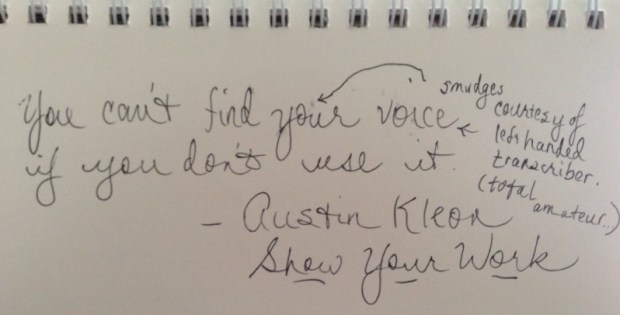
You can't find your voice if you don't use it.

A few valuable posts on author’s voice…

Reclaiming My Writer’s Voice
by Kay Bolden

My favorite lines from the post:

The keyboard and the screen made it far too easy to distance myself from my words. To sink into sales mode or trope mode or campaign mode. When I write by hand, I lead with my body, not my brain.

How I Found My Writing Voice and How You Can Find Yours:
A Metaphor Involving Sandwiches
by Carly Mae

Some favorite lines from this post:

Our writing is not genuine, we don’t feel like ourselves, or it’s stilted and mechanical — feeling more like a “I have to write” versus “I want to write.”

If you feel that way, you might be lacking your voice.

***

The biggest reason your writing feels mechanical and stilted is because it is. It’s not you. So when you read it, it probably sounds fake.

Your audience reads it that way it too.

View at Medium.com