Don’t ever write anything you don’t like yourself and if you do like it, don’t take anyone else’s advice about changing it. They just don’t know.
RAYMOND CHANDLER
***
Write for fifteen minutes every day. Set a time in advance, set a timer. Try to write at the same time every day. Your subconscious will get used to the idea and will start to work like a reliable water spout.
NAOMI ALDERMAN
***
The terror of the white page never goes away, no matter how much you publish. Do you know how terrified I was this morning, as I woke up and walked into my latest novel? And it doesn’t get any better. Every time I finish a piece of work, I am completely terrified that I’m going to be found out, that I’m a charlatan, that I have nothing left anymore. That I can’t do it anymore. It’s no good; I’ve lost touch. Through all of that, you find another block of stone. You just continue to carve and chip away.
COLUM McCANN
***
Thanks to Jon Winokur–via his Twitter feed– and his Advice to Writers for these first three quotes.
My first recipe from 11 days ago…Thank you, Epicurious.
So, yes, much like the summer of 2010 when I was laid up after Achilles tendon repair, I, like millions of others, am experiencing ‘restricted routines’. Hey, gotta do the right thing for others, including our front-liners. No complaints here.
And, as in 2010, it’s freed me up for another round of…
“30 New Recipes from 30 Sources in 30 Days” Subtitle: “Without Gaining 30 Pounds”
Okay, now this is weird. I’m revisiting the recipe and son of a gun if I forgot the eggs!
But it’s three hours after breakfast and it just hit me!
This recipe’s batter called for a quarter cup of flour, which is not something I’ve used in the past, and evidently, that supplied enough substance and adherence qualities [‘stickiness’ is really the better word] that I didn’t notice the lack of eggs. Weird.
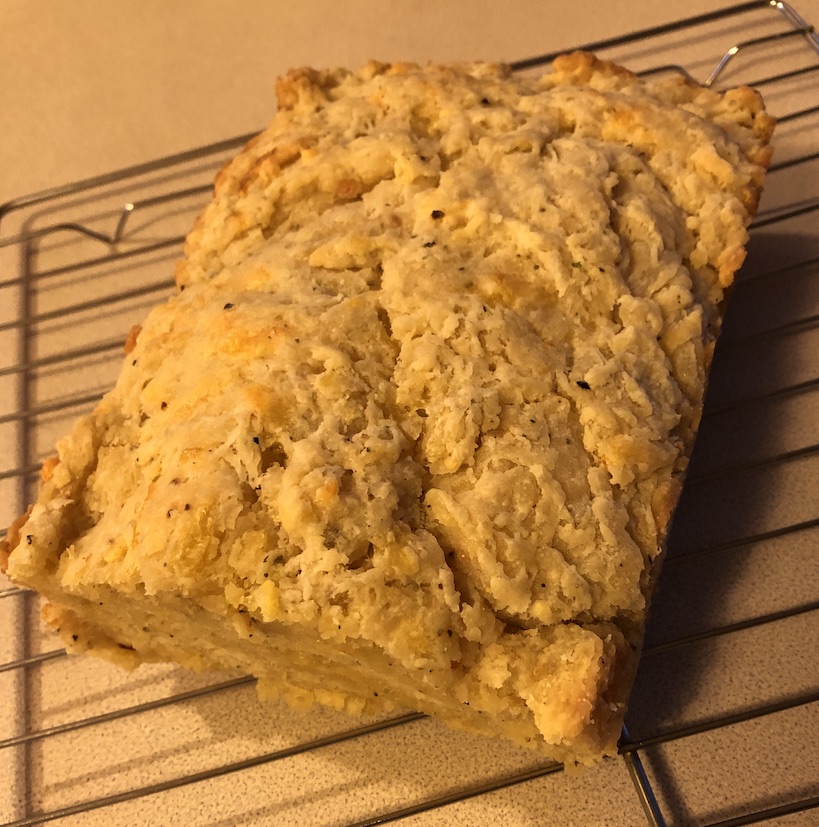
Probability: You throw in enough of the good inner stuff, you don’t notice shortcomings. Case in point: I’m not proud of its appearance–I can tell you, the wrestling match just to get this on the tray was not a pretty sight–but this stromboli-saurus recipe earned a ‘repeat visit’ award.
My apologies to Lauren’s Latest…her final product was much more pleasing to the eye. ‘Ugly Delicious’ folks: are you reading this?
Speaking of ‘inner stuff’, there was no reason to stop at peanut butter, so I pulled out black cherry preserves and a thick blueberry sauce that accompanied the flourless chocolate cake I’d made four days prior.
Half the fun of ‘following’ recipes is taking the detours. [Thank god there isn’t a Siri or Google Maps in the culinary world. That digital chorus would be endlessly yammering at me. “No, you nimrod, don’t double the cheese!”]
My final detour at breakfast: “Well, there’s still batter left…I wonder if I tossed in a wad of brown sugar and a glop of the blueberry sauce and then soaked the bread…”
Yep, I’d do it again. And maybe next time, a little creme de cassis or brandy wouldn’t hurt.
And speaking of detours…do this: While you’re eating, close your eyes. My experience: The food’s taste is ramped up. [Drawback, so is the sound of your chewing and chomping.] It seems to follow the truism that taking away one sense heightens the others.
So, what does all this have to do with writing? Experimentation in writing, as in cooking, can be a pleasant little kick in the seat of the pants.
This quote from William Zinsser [On Writing Well is his best-known work.] takes an opposite tack to yesterday’s Writing With No Direction post.
Writing is linear and sequential; Sentence B must follow Sentence A, and Sentence C must follow Sentence B, and eventually you get to Sentence Z. The hard part of writing isn’t the writing; it’s the thinking. You can solve most of your writing problems if you stop after every sentence and ask: What does the reader need to know next?
This snappy piece by David Ben-Ami really speaks to the value of Julia Cameron’s ‘morning pages’. (Dropping two names in one sentence. Have I no shame?)
The ordinary writer is bound to be assailed by insecurities as he writes. Is the sentence he has just created a sensible one? Is it expressed as well as it might be? Would it sound better if it were written differently? The ordinary writer is therefore always revising, always chopping and changing, always trying on different ways of expressing himself, and, for all I know, never being entirely satisfied.
–ISAAC ASIMOV
It’s easy to urge each other to crank out ideas and imagery.Countless articles and posts urge us to dive in and heat up that pen or keyboard.But what about those next steps, where the real work kicks in?Copyblogger editor-in-chief Stefanie Flaxman’s Traffic Light Revision Technique weaves much-needed, but often elusive, objectivity into her approach to revision/editing.
Let’s boil it down:
Read over your material in a word processing document. [‘Document 1’] Color-code your sentences–green for ‘okay with me’, yellow for ‘needs some work’, red for ‘needs complete overhaul’. [Note: Use your own file-naming strategies.]
Save ‘Document 1’, without any further tinkering.
Create a copy of ‘Document 1’ [‘File’, ‘Save as…’], complete with the colored highlights. Name it ‘Document 2’.
Edit Document 2, recoloring your sentences green when satisfied with the work they’re doing.
Proofread your work [aloud is always a good idea] with the following question as your beacon:
 Henry Miller’s 11 Commandments of Writing




 Word Inventions